
K4T9QM
You found it.
It wasn't hidden, exactly. The code sits at the end of a short clip on the homepage, in plain view, and almost nobody looks twice. Following one is roughly the whole mechanic — a code on one screen, and a comparison on the other side of it. So here's one in full. Two people, start to finish, none of the tour.
BEFORE
Two people, separately.
Marlin answered twenty questions about the kind of relationship that fits his life, and rated dozens of factors on what he prefers and how firmly he holds it. Allie did the same. Neither saw any of the other's answers, and neither was answering about the other. They were describing themselves.
Then they chose to compare. Four steps, either of them free to stop at any one. Nobody stopped.
STEP ONE
The word for what each wants.
Marlin
SCOM FlexScore 46Allie
SCOM FlexScore 44Both are SCOM — structured, and looking for commitment. They want the same kind of thing, which is the first question and nowhere near the last one. Plenty of people who want the same kind of thing are a disaster together.
STEP TWO
Forty-six and forty-four.
Two points apart, both somewhat flexible. Which sounds like a strong signal and mostly isn't — the number is the least interesting thing on this page. Two people can land on the same FlexScore by being flexible about completely different things. The total tells you how much give someone has. It does not tell you where.
STEP THREE
Where the give actually is.
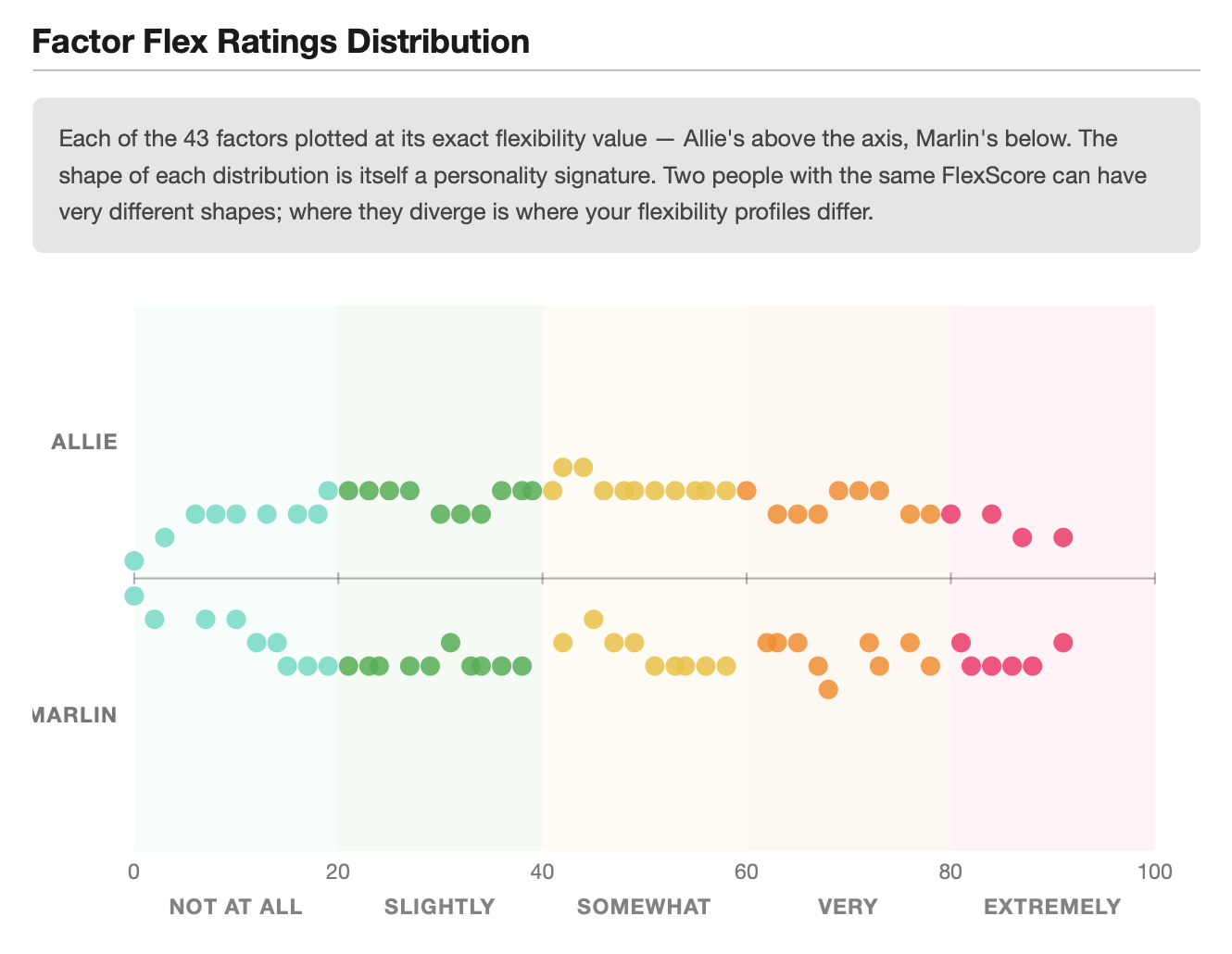
This is the picture a number can't give you. Read down the columns rather than across: the places where one person's cluster sits under the other's empty stretch are the places a conversation is coming.
STEP FOUR
What each of them sees.
Every factor they both answered, sorted from exact agreement through to outright conflict. The report is built twice — once against Marlin's tolerance, once against Allie's — and this is where the two versions stop resembling each other.
Marlin's view
15
Exact match
35%
17
Compatible
40%
7
Potential issue
16%
4
Major difference
9%
0
Serious conflict
0%
Three quarters of it lands in the first two columns, which is the part people want to celebrate and the part that matters least. The four in orange — alcohol, travel, conflict, gambling — are specific, named things that would otherwise have surfaced in year two, in an argument, at the worst possible moment. Nothing in red at all. Reading this, Marlin would conclude they're fine.
Allie's view — the same two people, the same answers
15
Exact match
35%
16
Compatible
37%
7
Potential issue
16%
2
Major difference
5%
3
Serious conflict
7%
Nobody's answers changed between those two charts. The only difference is whose tolerance is doing the measuring. Where Marlin has nothing in red, Allie has three — sex, romance, openness — and two of those sit in his Compatible column. He'd read his report and relax. She'd read hers and see the three things she can't bend on.
That asymmetry is the whole reason the report has two sides. A single compatibility score, however carefully built, would have averaged these two pictures into one number and told them both something false.
Nobody matched them.
Nothing was decided for them.
No score said yes or no. No algorithm ranked them against anyone else. Two people who had each been honest with themselves put the answers side by side and read them — and each walked away knowing which conversations were theirs to start.
Marlin and Allie are demonstration records, not real people — but the numbers on this page are a real run through the real comparison.