Alex had been on the apps for years. Profiles filled out, photos updated, conversations
started and abandoned, occasional dates that went somewhere and more often didn't.
The work of dating had become its own thing: a part-time job whose product was
mostly nothing.
When Alex found Rōmational, it didn't look like another app to optimize. It looked like
a place to sit down. Twenty questions about what she actually wanted from a relationship.
Dozens of factors covering everything from kids and finances to social pace and
household labor.
Alex answered honestly. As honestly as she could, that first time.
The questions weren't asking who Alex was. They were asking what she wanted.
02
BDAT.
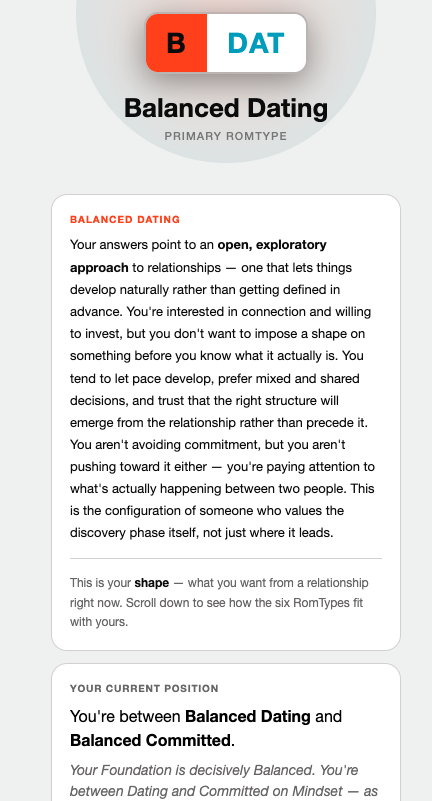
The result came back: BDAT. Balanced. Dating.
Alex's first RomType result: BDAT.
The app's description of BDAT read like someone had been watching her life:
Your answers suggest you're approaching relationships openly and
exploratorily, letting their shape emerge rather than setting it in advance.
This is the configuration of someone who values the discovery itself, not
only where it leads.
It was an honest answer for where Alex was. Not searching urgently. Not avoiding either.
Believing the right person would show up if she stayed open.
A RomType isn't a personality. It's a shape: the kind of relationship that fits
a life, at the moment the question is asked.
03
Dozens of factors. Flexible on most of them.
Then came the factors. Kids, faith, finances. Conflict styles, communication, cleanliness.
The rhythm of social life, the shape of family obligations, the question of whether to
keep separate accounts or merge them.
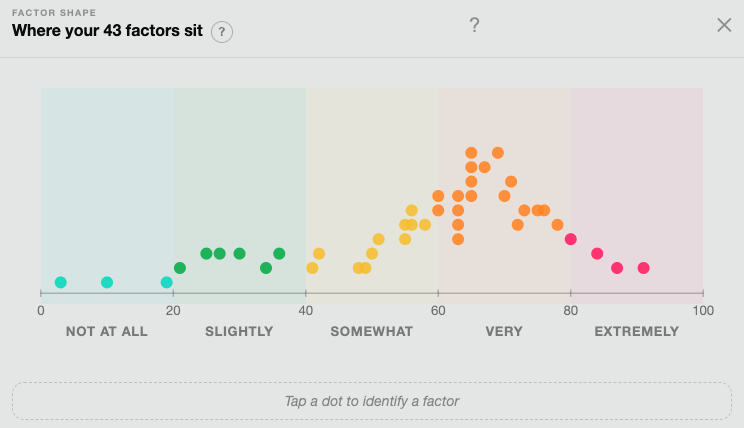
Alex's first FACTOR SHAPE: flexible on most things.
Alex answered each one. Most of the dots landed on the flexible side of the scale:
very, somewhat, open to it. A few harder edges came through.
But mostly: openness.
The FlexScore came back at 56. Above the middle. Generous, by the math.
It felt right. Alex had always thought of herself as easygoing, willing to
meet someone halfway, willing to make it work. The number on the screen looked like
a fair description.
The first time you take this assessment, you answer with the self you understand
yourself to be. It takes a while to notice which of those answers were the apps
talking, not you. Nobody is fluent in a new language on the first attempt.
04
Then time did its work.
A few weeks later, Alex came back to the assessment. Just to check. The answers were
mostly the same.
A few weeks after that, again. A handful of small edits. Nothing dramatic.
That's how it went, through the rest of that year. Alex came back when something
made her want to. Sometimes after a date that had gone nowhere. Sometimes after a
friend's wedding. Sometimes just on a Sunday morning when nothing in particular was
happening.
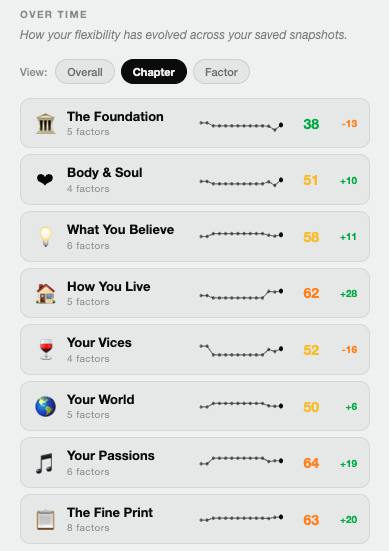
Every chapter of Alex's life, drifting a little. The Foundation, tighter.
How You Live, looser. Most others, somewhere in between.
The answers shifted, a little at a time. Each visit was small. The Sundays added up.
By month nine, her chapter-level scores had moved across the board, some
toward more commitment, some toward more flexibility, depending on the domain.
The product isn't designed for one big moment of clarity. It's designed for the
slow accumulation of them — practice, time, and everything you pick up from
other people along the way.
05
Then one Sunday, Alex retook the whole thing.
There are two rhythms in Rōmational. The factors drift. You adjust them as
life shows you new things, one at a time, with no ceremony. The RomType is different.
You don't drift through those twenty questions. You sit down and retake them when
something tells you the underlying shape might have changed.
Alex's factors had been getting attention all year. The RomType, she hadn't touched.
Until that Sunday.
The app, before letting Alex change anything, made sure she knew what the change
would and wouldn't do.
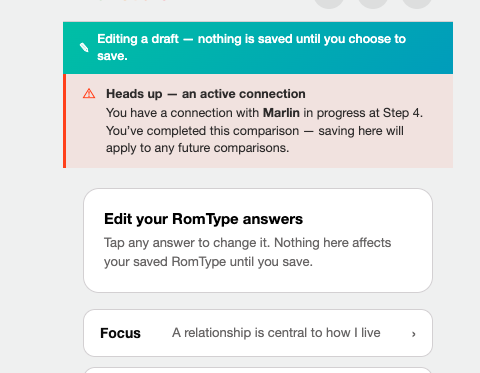
The app didn't quietly open the form. It told Alex, plainly, that there was an
active comparison in progress (with Marlin, at Step 4) and that any
update would apply to future comparisons, not to that one. The past would stay as
it was. She understood, and continued.
Alex didn't go in to fix specific answers. She went in to take the assessment
again, fresh: twenty questions, as if for the first time.
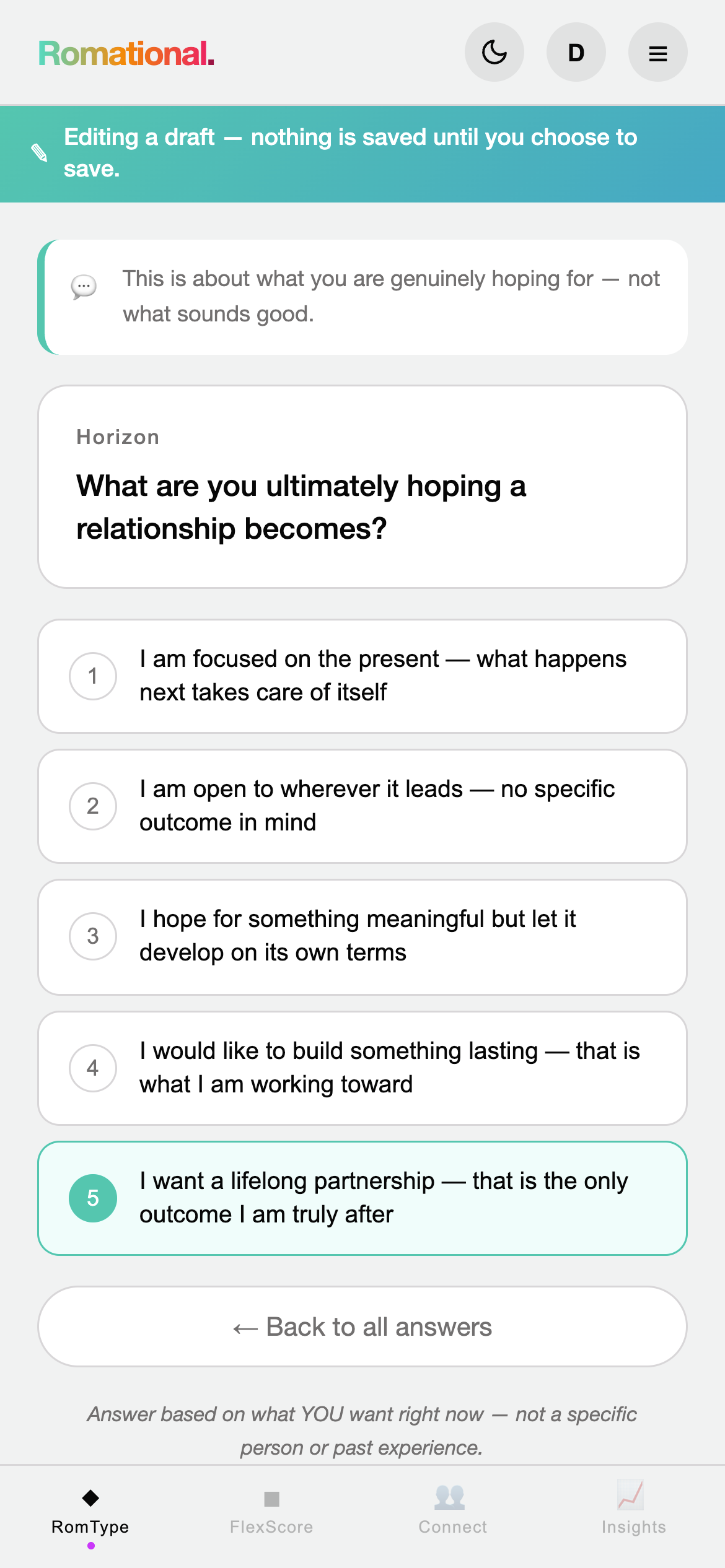
Each question came with quiet instructions to stop performing.
Each question came with the same quiet instruction. This is about what you are
genuinely hoping for — not what sounds good. And again, at the bottom:
Answer based on what YOU want right now — not a specific person or past
experience. The app, in two short lines, kept asking Alex to stop performing.
Horizon. What are you ultimately hoping a relationship becomes? A year ago,
Alex had answered somewhere in the middle. This time, she answered I want a
lifelong partnership — that is the only outcome I am truly after.
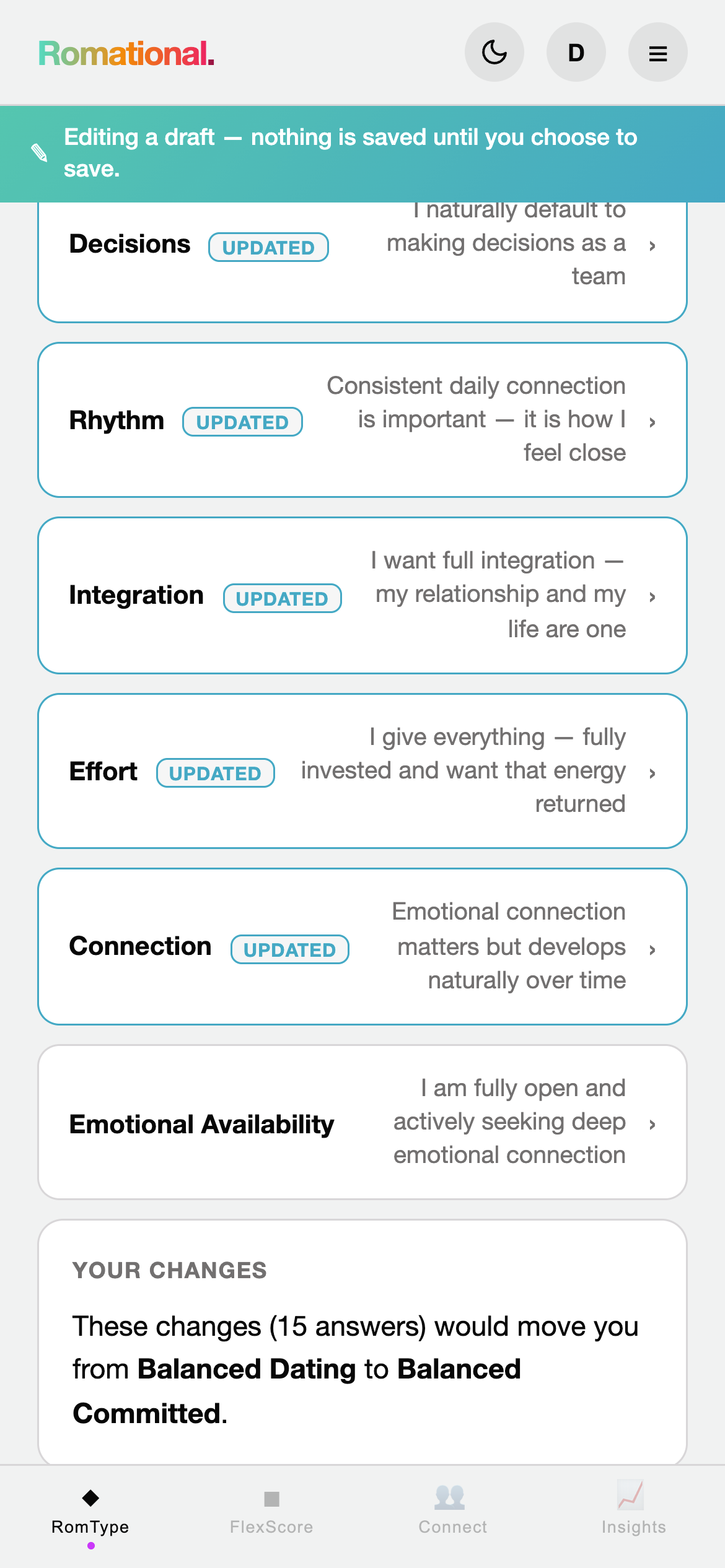
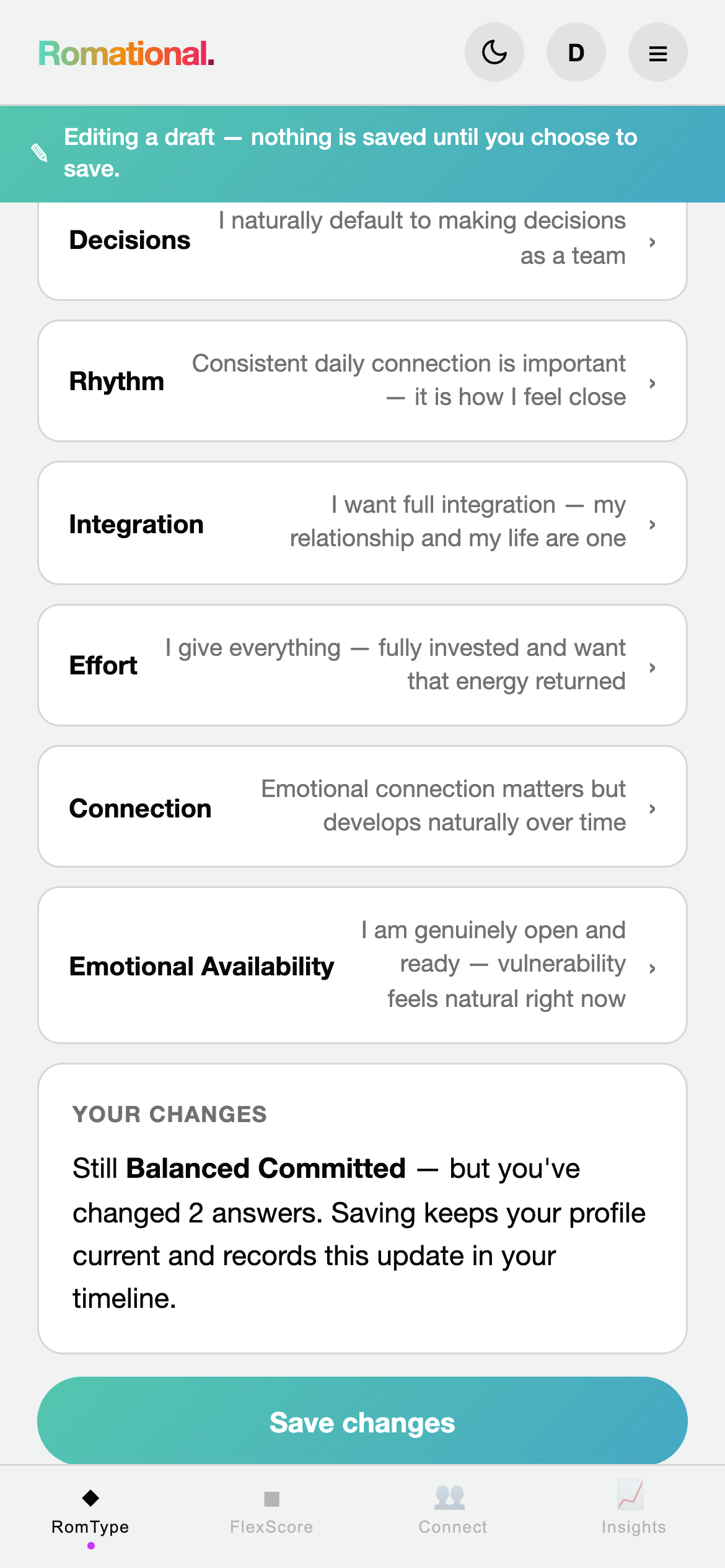
Question after question, the same kind of move. Decisions: as a team. Rhythm: daily
and connected. Integration: full, not a separate life with a relationship in
it. Effort: all in. Emotional Availability: actively seeking depth. By the end,
fifteen of the twenty answers had come back different from a year ago.
The app, telling Alex what was about to happen.
Before saving, the app showed Alex what the changes would do.
These changes (15 answers) would move you from Balanced Dating to Balanced
Committed. Not as a surprise. Not after the fact. As a preview.
She looked at the message for a moment. It was the first time anyone, or anything,
had said it plainly: that's where you've moved to. She saved.
Nobody else saw any of it. Alex didn't post anything, didn't message anyone, didn't
change a profile elsewhere. The update happened in private, on her own device, with
no audience.
The system didn't change Alex's RomType. Her honest answers did. The system just
noticed.
06
Then Alex looked back.
The notification was small. The Insights view was where the change actually lived.
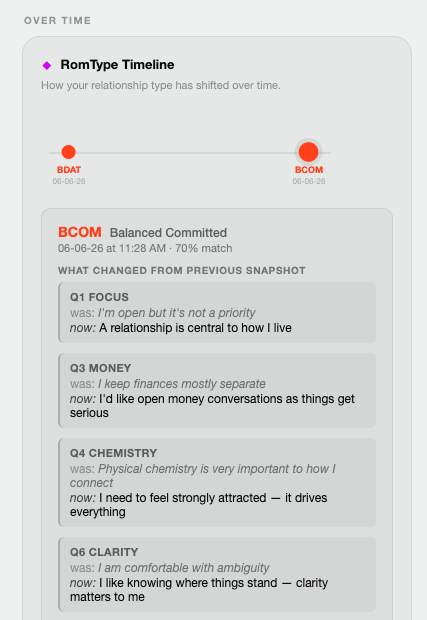
She opened it. The RomType Timeline showed just two dots: where she'd started,
in BDAT, and where she was now, in BCOM. The
timeline only records moments the RomType actually shifted, and over the year, it
had shifted once.
A year, drawn from Alex's own answers.
It wasn't a story she would have told herself a year ago. But there it was.
Drawn from her own answers, on her own days, in her own words.
Not a personality test. A record.
This is what Rōmational is for. Not telling you who you are.
Showing you who you've been.
07
Smaller things had shifted too.
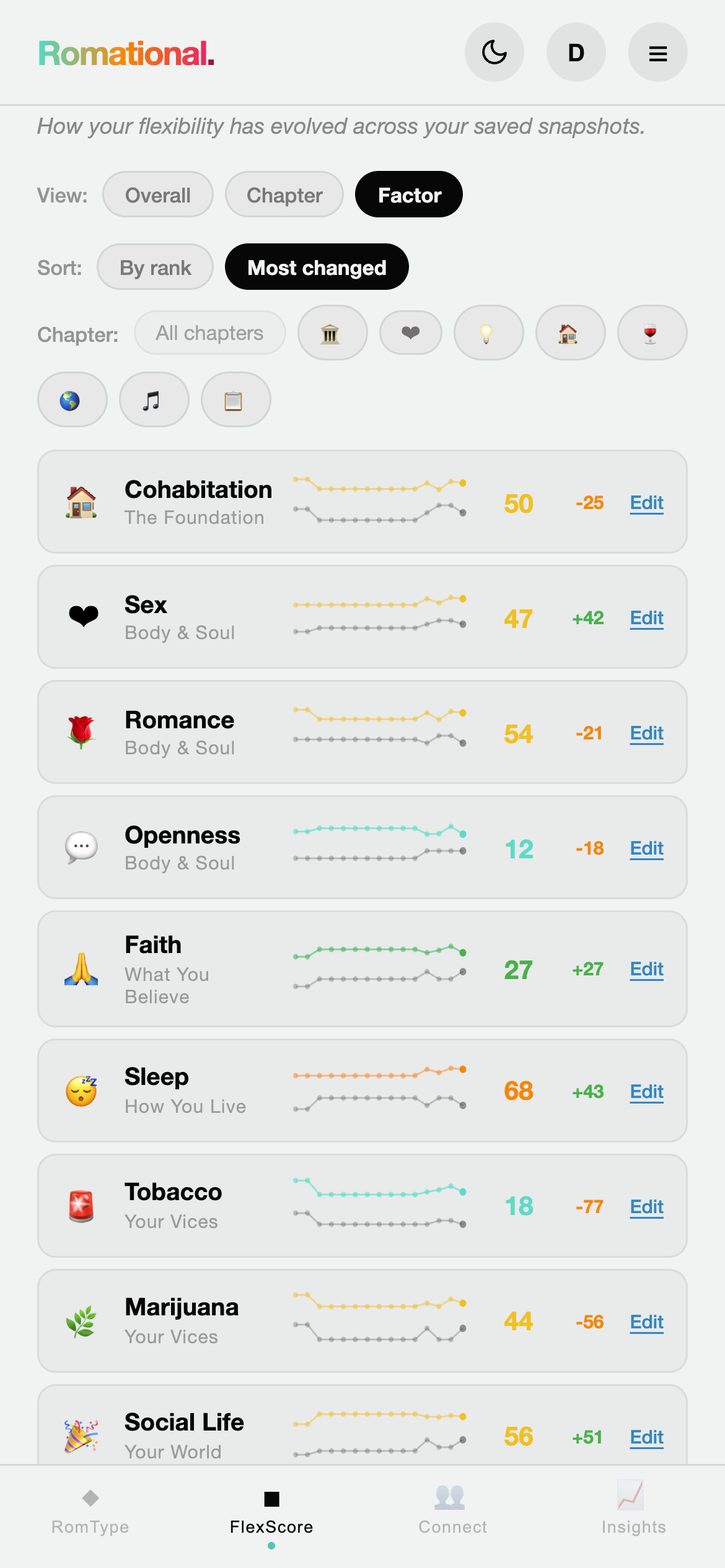
Below the RomType Timeline, the Insights view showed which of Alex's
factors had moved the most over the year, sorted by how dramatically each
had shifted.
Nine factors stood out. The pattern was hard to miss.
Some things had tightened. Cohabitation had moved from open-ended to
important: Alex wanted to actually live with someone. Romance,
the same. Tobacco and Marijuana had swung the hardest, both
toward dealbreaker. Openness (how honest a partner was willing
to be) had tightened too.
Some things had loosened. Sleep schedules, once a sticking point, no
longer were. Social Life pace, the same. Even Sex and
Faith had become more flexible, not because they mattered less,
but because Alex had stopped expecting a partner to match her in detail.
Nine factors. A clear shape.
The factors that hardened were about how committed someone would be.
The factors that loosened were about how similar someone needed to be.
Alex was no longer looking for a mirror. She was looking for a partner.
That's where Alex is, now.
Three answers refined. The RomType holds steady. The practice continues.
The RomType says BCOM. The FlexScore says 56, a little tighter than it was a
year ago, but not much. The Dealbreaker Drift card shows nine factors that stood out
of the sixteen that moved. And every few weeks, Alex sits down for a small refinement: an answer that doesn't quite fit anymore, a factor that has earned a closer
look. The RomType holds steady. The profile stays current.
Alex had been using Connect all along. But the comparisons had been running on a
version of her that wasn't a true representation of what she actually wanted: the easygoing, flexible Alex who was open to anything. The matches that came back
from that Alex were matches for that Alex. They never quite fit.
The old comparisons are still there, untouched: records of who Alex was and
who anyone else was, on the days they each agreed to look. Some are now quietly
flagged as no longer reflecting her current state. She can revisit any of them.
None of them have been rewritten.
What's different is what happens next. The next comparison will run on a version
of Alex who actually exists. Some old matches won't look like fits anymore. New
ones might become possible. Either way, the answers she gets back will be answers
to a question she was actually asking.