Rōmational is, first, a philosophy and a language: a way of describing relationships that doesn't reduce people to checklists or performances. To put that philosophy into practice you need somewhere to actually do the work — somewhere private, where what you discover about yourself stays yours.
The clearest way to show what that looks like is to follow two characters through the app. Meet Marlin and Allie. Both have firm convictions about what they need. Both have a story. Both are about to know themselves better.
Marlin and Allie are familiar fictional characters used here as demo profiles, with answers authored to illustrate distinct shapes. The screens shown are real screens from the app, populated with their real demo data.
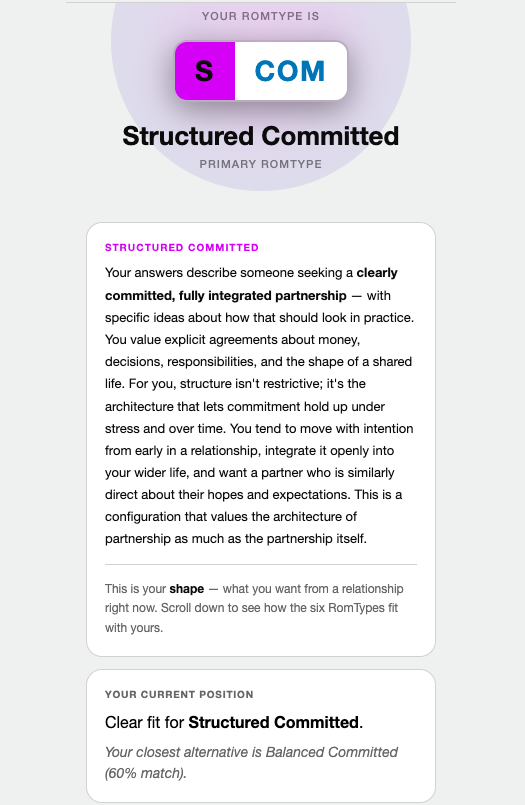
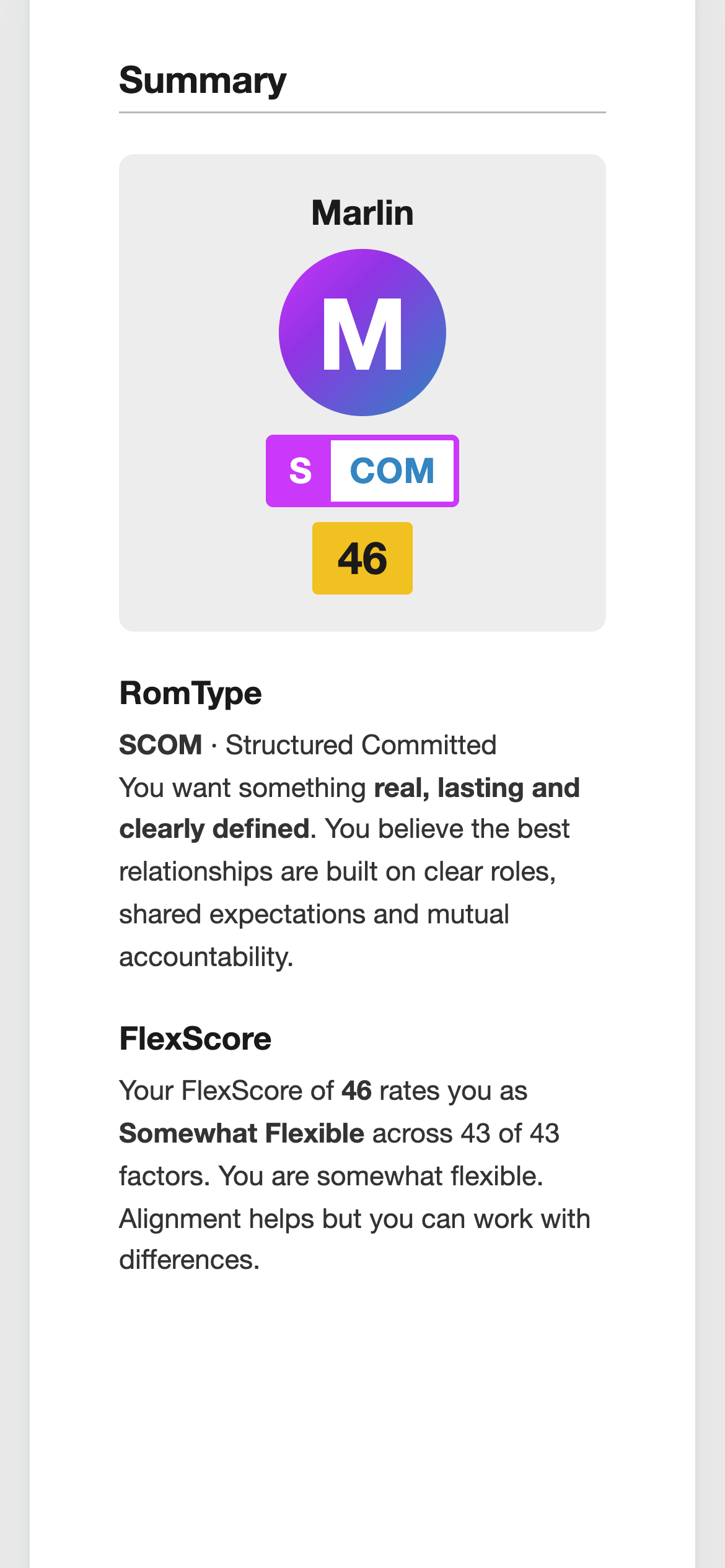
A single father from a beloved animated film. Anxious by nature, protective by choice, sure of what matters to him. In twenty questions, the app names what kind of relationship he's actually looking for.
This is what self-knowledge looks like in twenty questions.
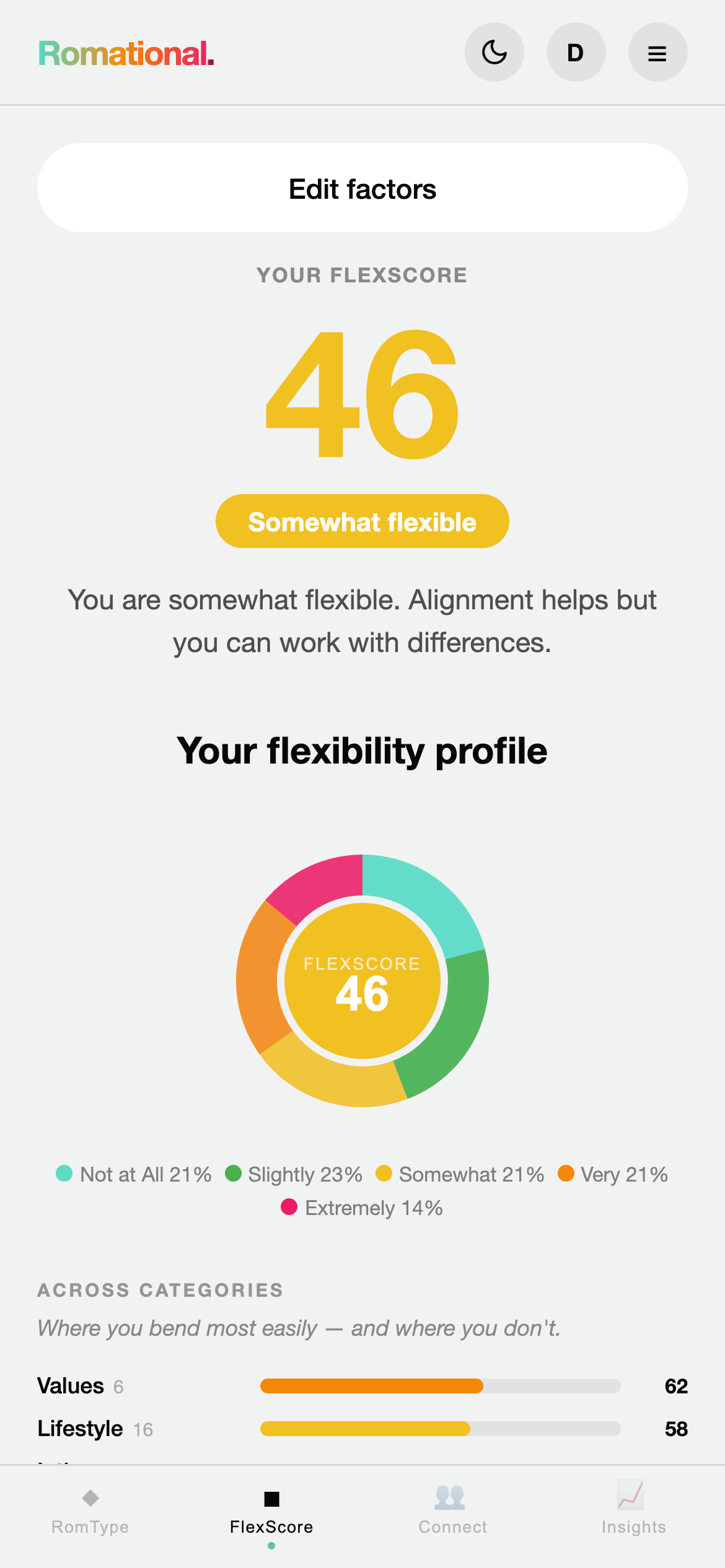
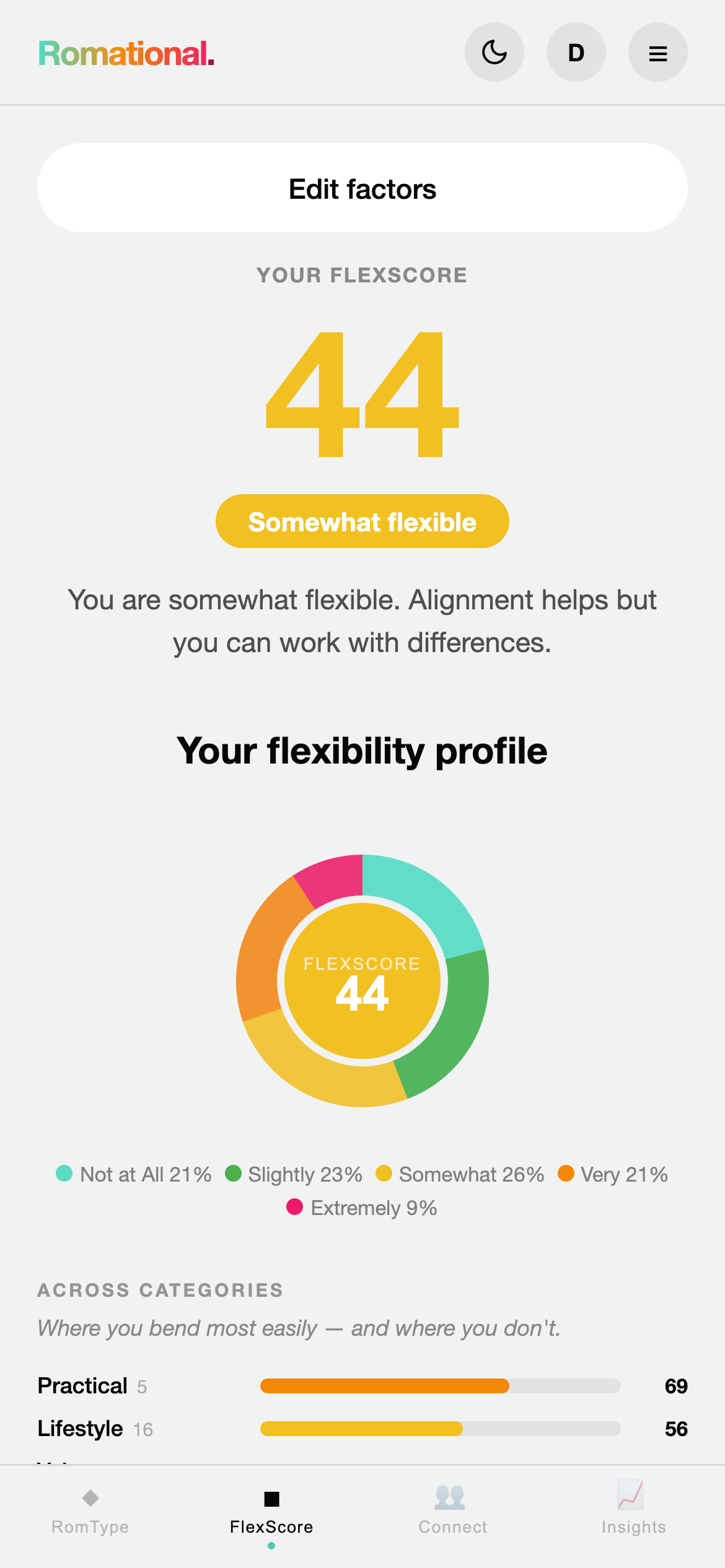
Forty-three specific factors — kids, faith, finances, sleep, conflict, communication, the whole inventory of things that quietly shape a relationship. On each one, how much can Marlin actually bend? His FlexScore captures the answer.
Not a personality test. A map of his real positions.
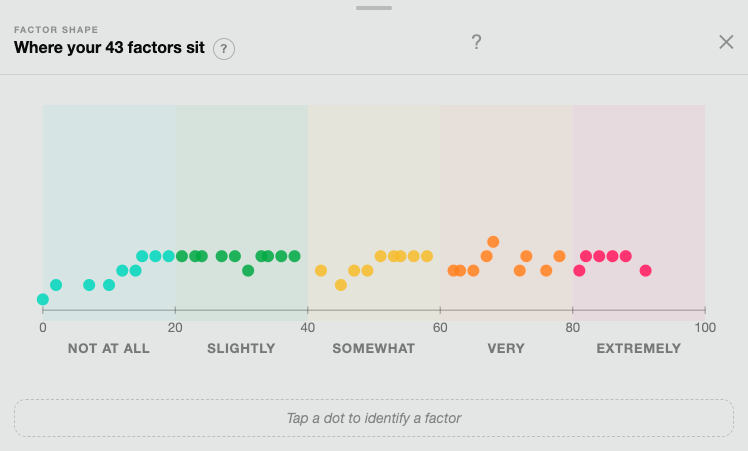
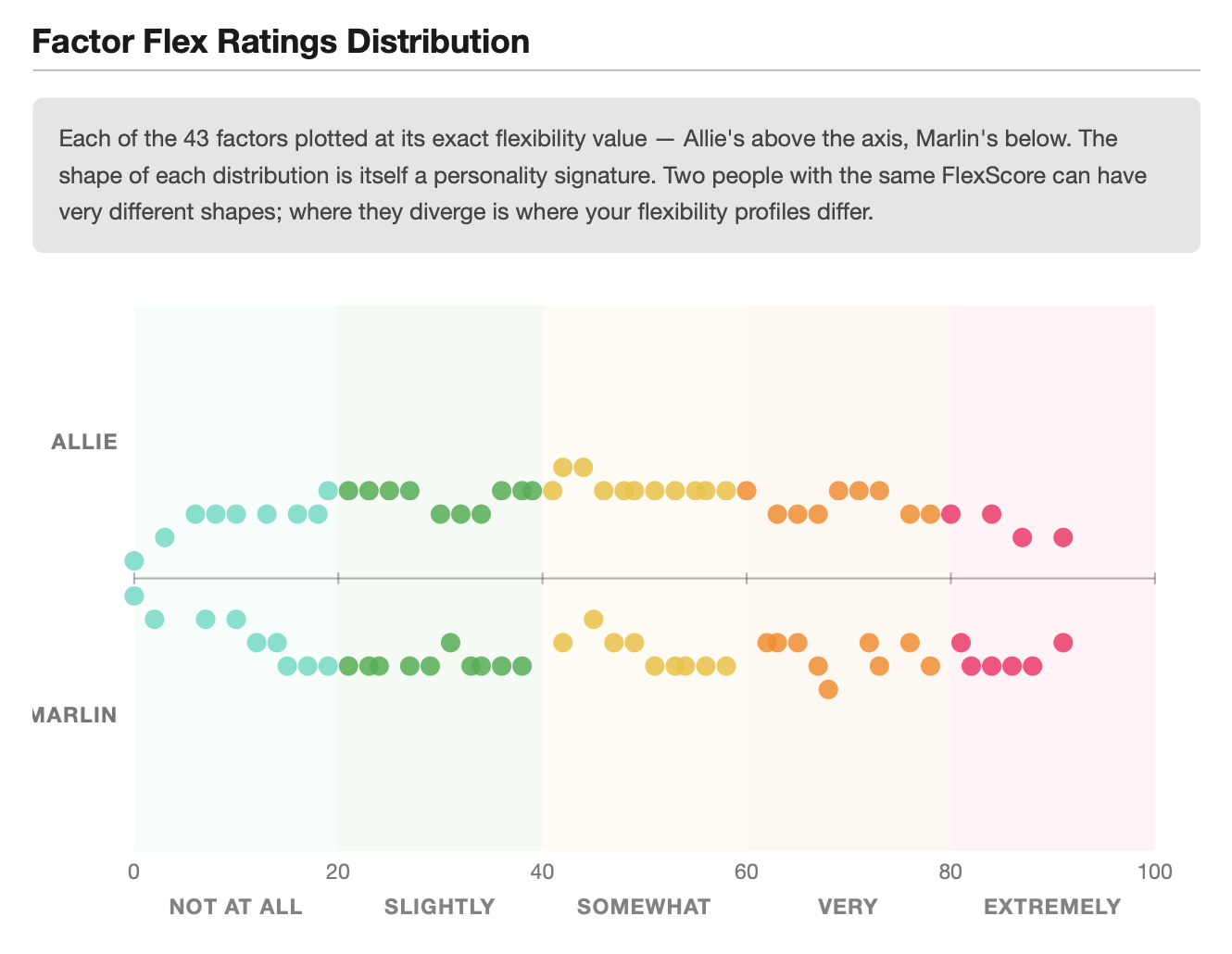
Every person's flexibility has a shape. Marlin's cluster on the left tells you he has clear non-negotiables — and the dots show you exactly which factors those are. Someone with a wider, more even distribution would look entirely different.
Shape matters. Nothing else captures this.
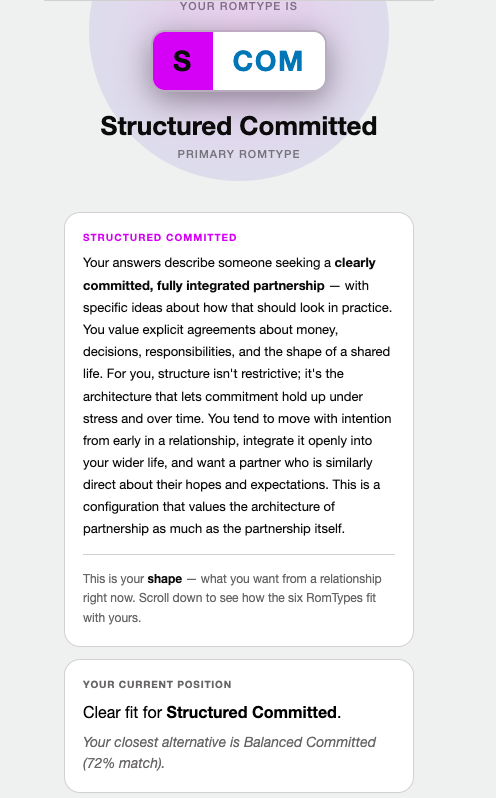
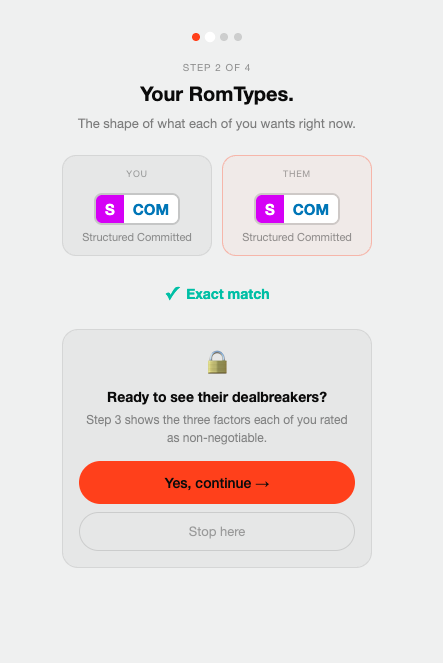
A romantic from a different kind of story, with her own clear sense of what she needs. Same RomType as Marlin — SCOM, Structured Committed. Same private process. Different flexibility, different signals, different details. You'll see her shape later, next to his.
Each person has their own coherent answers. Then what?
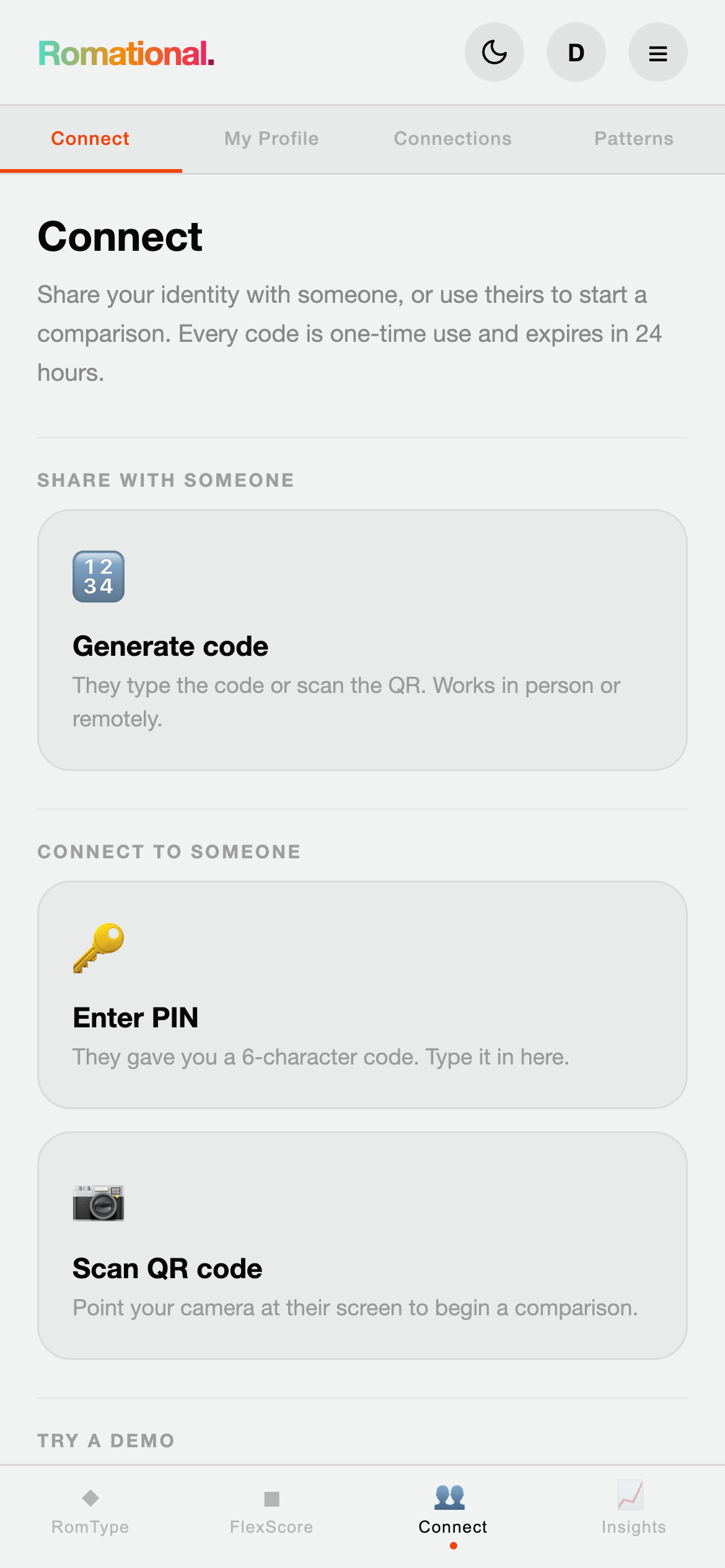
If Marlin and Allie wanted to compare honestly, here's how it would start. One generates a code. The other enters it or scans the QR. Both have to agree before anything is compared. No profiles to scroll. No public-facing identity. Just a moment of mutual consent, in person or remote.
No profiles. No swiping. Just consent.
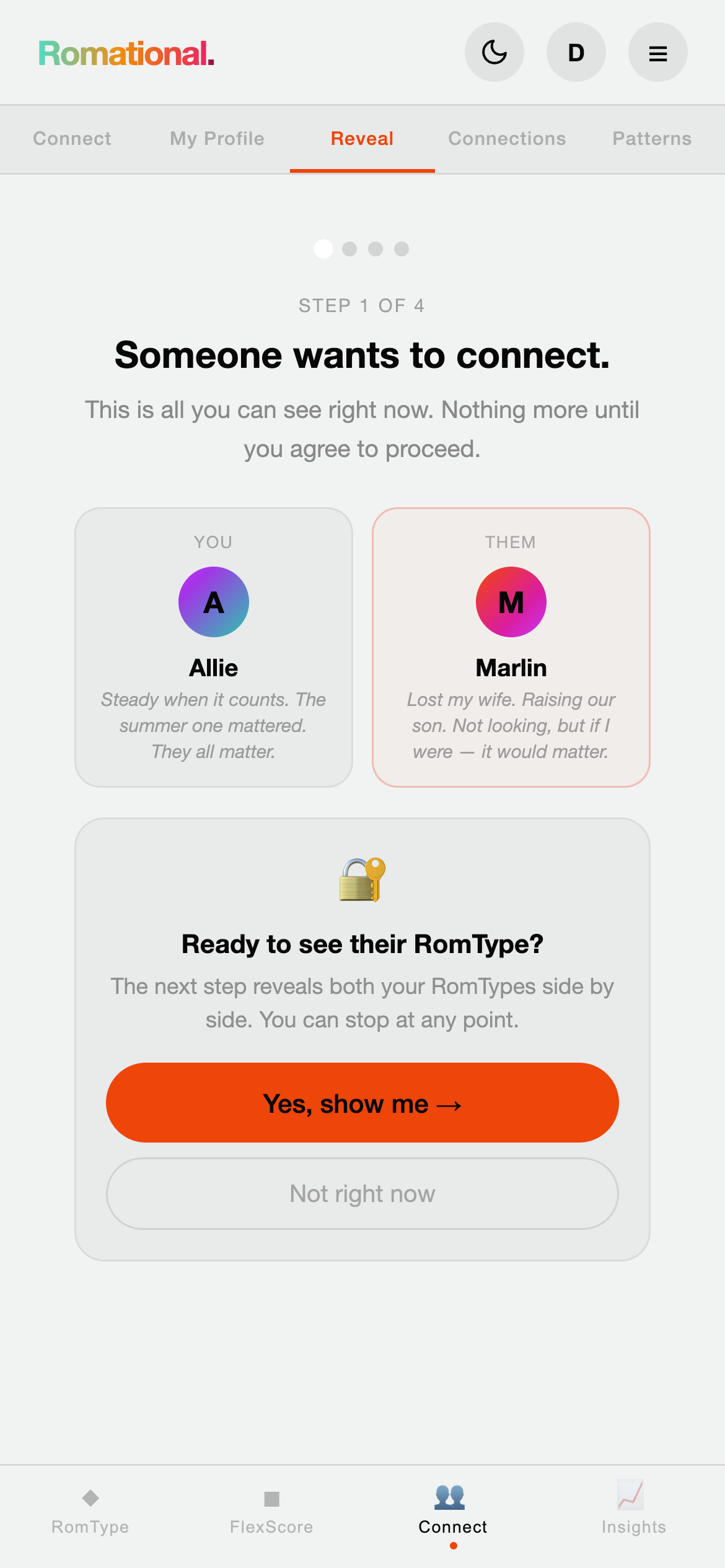
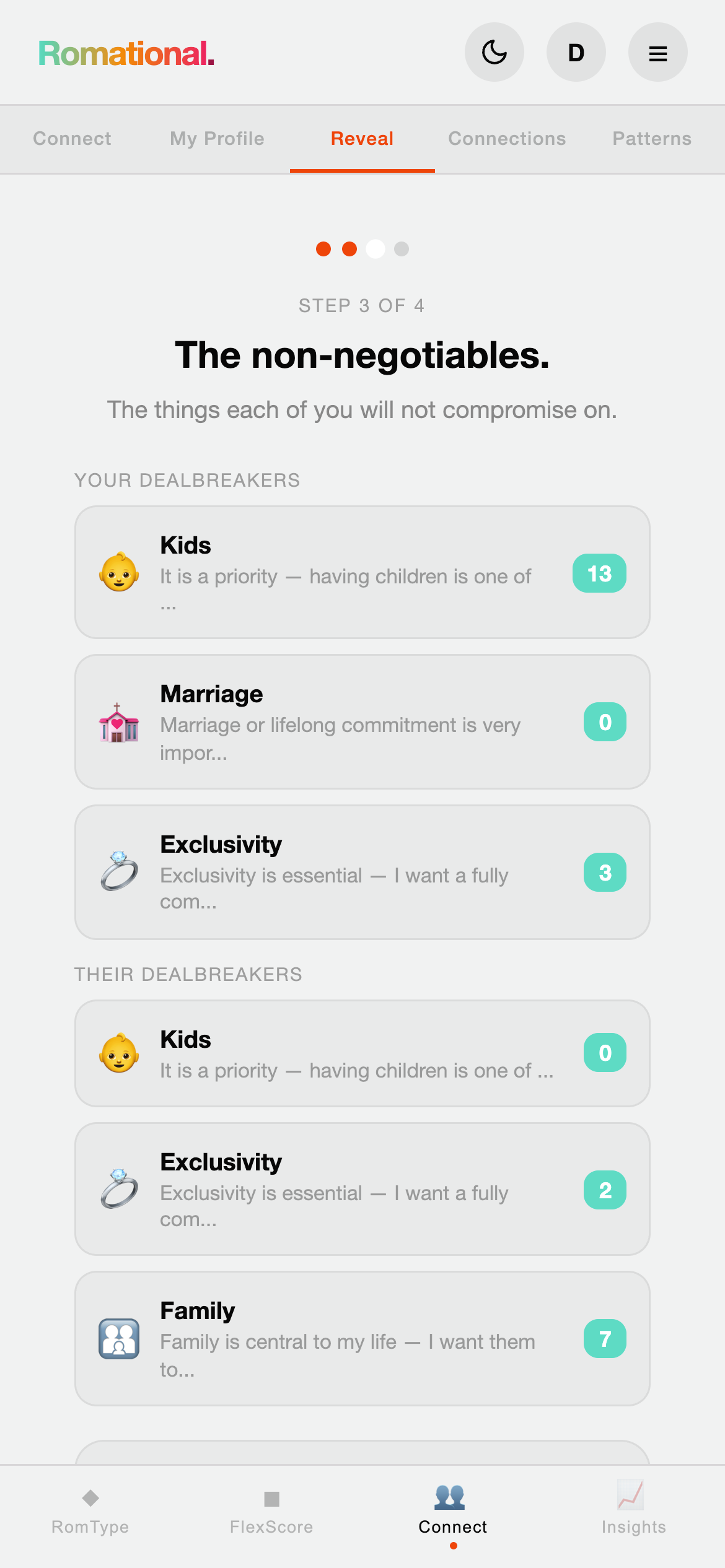
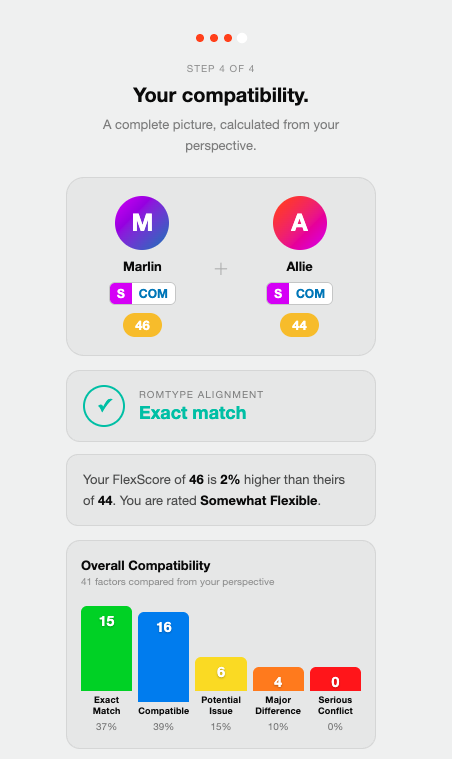
Comparison happens in steps. A gate first — both parties confirm before any data is shared. Then RomTypes, side by side. Then each person's top non-negotiables. Then the full picture: compatibility tier-by-tier across every factor compared. Nothing is revealed at any step without explicit consent at the one before.
Both stay in control of what's shared. Every step.
When they've both said yes through every step, the full comparison opens. Marlin sees the complete report from his perspective. Allie sees it from hers. The strip plot below shows both their shapes overlaid — the alignments, the gaps, what each gap actually means.
Clarity replaces guessing.
Whether they meet someone to compare with or not, both Marlin and Allie leave with a complete record of who they are right now. A document, not a profile. Something they own, something they can return to, something they can choose to share.
This is the artifact. The product.
What you just read is the philosophy in practice. Rōmational is the app that makes the practice possible.
It is not a dating app. There is no profile to perform on, no feed to scroll, no one matching you with anyone. It is a private place to do the work Marlin and Allie did — and then, only if you choose, a way to compare with someone who has done their own.
No profiles. No one watching.
An honest practice. Yours, on your terms.
Request an invitationThe only entry requirement is the willingness to be true to yourself and to others.